
Headers & steam headers
Headers bring steam, water or gas together and distribute it again. We supply them as a complete welded assembly to your drawing – shell, branches, flanges and end cap fitted, tested and documented.
Scope of supply & execution
| Item | Detail |
|---|---|
| Basis of manufacture | Drawing with nozzle layout, pitch and angular position |
| Main body | Seamless pipe DN 50 to DN 800, wall thickness as designed |
| Nozzles | set-in, extruded or with weld-in nozzles, to drawing |
| End caps | torispherical, semi-elliptical or flat, welded on |
| Connections | weld end, flange to EN 1092-1 or ASME B16.5, socket |
| Materials | P265GH, 16Mo3, 13CrMo4-5, 10CrMo9-10, 14MoV6-3, P91, X20CrMoV11-1 |
| Welding | qualified procedures with WPS/WPQR, preheating and PWHT to suit the material |
| Testing | NDT of the welds as specified, pressure test with report |
| Documentation | 3.1 or 3.2 certificate to EN 10204, weld and test plan, WPQR |
| Pressure equipment directive | classification by PS, volume and fluid group; category and module as you specify |
| Tolerances | geometrical tolerances to drawing, general tolerances to ISO 2768 and ISO 13920 |
Materials we supply for this
The grade follows from medium, temperature and pressure. The list below is a selection, not a limitation – we supply the grade that design and specification call for. Each grade has a data sheet with composition, properties and standards.
Typical fields of use
- Inlet and outlet headers of superheaters and economisers
- Distribution headers for membrane walls in the boiler
- Steam headers for several consumers in the process plant
- Feedwater and circulation headers
- District heating transfer stations with several outlets
- Spare parts for outages and boiler revamps
The records you receive
Inspection certificate 3.1 or 3.2 to EN 10204
Batch-related test results for every pressure-bearing item, countersigned on request.
Non-destructive testing
Visual, penetrant, magnetic particle, ultrasonic or radiographic testing of the welds as specified.
Pressure test
Hydrostatic test to the applicable code and drawing, with test report.
Traceability
Batch and heat number of every item remain traceable through the documentation.
From drawing to delivery
1. Drawing or sketch
Send us the drawing, isometric or bill of material – a hand sketch with dimensions is enough to start.
2. Agree material and code
We settle grade, standard, pressure rating and the required certificate with you.
3. Quotation
You receive a quotation with price, execution and a firm delivery date.
4. Delivery with documentation
The component arrives ready to install, with certificates and test reports.
Headers & steam headers – frequently asked questions
What is the difference between a collecting header and a distribution header?
Technically it is the same component. If it brings several lines together it is called a collecting header; if it distributes one medium from a single line to several, it is a distribution header. English uses header for both.
What is a steam header?
A collecting pipe that takes steam from one or more generators and distributes it through nozzles to several consumers. It is designed for the pressure and temperature of the steam; for superheated steam in creep-resistant grades such as 13CrMo4-5, 10CrMo9-10 or P91.
Which materials are used for headers?
This follows from the steam temperature. Up to about 400 °C P265GH is sufficient, to 530 °C 16Mo3, to 570 °C 13CrMo4-5, to 600 °C 10CrMo9-10 and to about 620 °C P91. X20CrMoV11-1 is used to around 580 °C.
What information do you need for a quotation?
Drawing or sketch with diameter, length and wall thickness of the main body, the nozzle layout with pitch and angular position, the material grade, design pressure and temperature and the required certificate to EN 10204.
Are the nozzle welds tested?
Yes. For pressure-bearing headers the non-destructive testing of nozzle and circumferential welds is part of the scope – usually magnetic particle or penetrant testing at the surface and ultrasonic or radiographic testing of the volume, plus the pressure test with report.
Do you supply the header complete or only the individual parts?
Both. The complete assembly is usual: tees, flanges and end cap are welded into the finished header, tested and delivered with documentation. If you assemble yourself we supply the parts cut to size with weld preparation to drawing instead.
What do category IV and module G on the drawing mean?
The category follows from pressure, volume and fluid group: at PS 45 bar, some 161 litres internal volume and fluid group 2 (steam), pressure times volume exceeds 3000 bar·litres, which gives category IV. Module G means unit verification: a notified body examines every single item, not a sample. That costs time and money and therefore belongs in the enquiry, not in the final inspection.
Can you quote quantity breaks?
Yes, and on assemblies it almost always pays off. From the second unit on, jigs, procedure qualifications and set-up are spread. Tell us the quantities you want to compare – we price them individually.
Send your drawing – we will clarify the rest together
A drawing, bill of materials or short description is enough to get started. If already available, the following details help us prepare your quotation quickly.
- Drawing with nozzle layout: pitch and angular position
- Material, or pressure, temperature and medium
- Header body: outside diameter × wall thickness and overall length
- Quantity and price breaks
- Certificate 3.1 or 3.2, NDT scope, required date
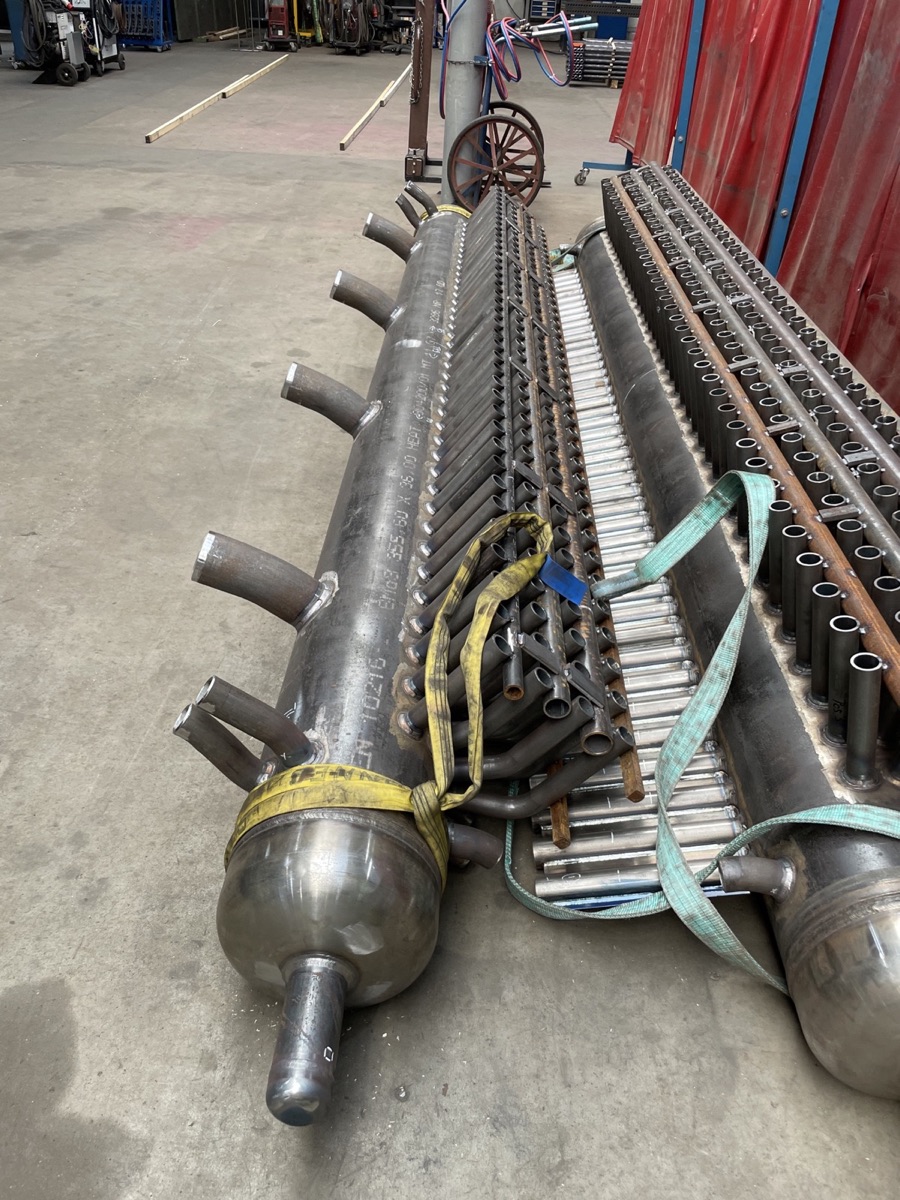
Headers & steam headers – request a quote
Drawing, material and quantity are enough – we come back with price and lead time.